Many children have grand dreams of growing up like becoming a footballer, a rugby player, or a soldier. Not many end up achieving one, but one Cardiff Rugby legend, Ivor Williams, must have been an undecisive child as he did all three and excelled at all of them.
Williams was born in 1910 in Bedlinog near Merthyr Tydfil and first picked up football at 17 years old. Within a few months, he signed with Cardiff City FC as a reserve goalkeeper where he played for three years. His first time on the pitch was a 1-1 draw against West Ham at Upton Park.
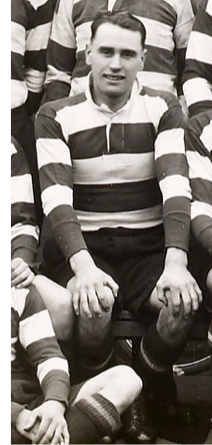
Ivor Williams in 1933
He then transitioned to the oval ball, and after only three matches Williams was invited to play for Cardiff Athletic in the 1931-32 season. His work took him across the Severn and he took to the pitch at Kingsholm with Gloucester. Williams would play 8 out of 10 of the last games in the 1932-33 season and made big enough waves to earn a mention in The Times preview for the 1933-34 season.
In February of 1934, Ivor Williams played in his first Welsh trial match though had an uncharacteristically quiet game and missed out on a Wales call up. However in the same season, he would go on to represent Gloucestershire multiple times, including the County Championship final against East Midlands.
Williams left his mark at Gloucester as a reliable try-scoring back row before his return to Cardiff in 1937. He once again found himself in a Welsh trial match in January 1938 but again fell short of a Wales call up. His uncharacteristic performance was noted by The Western Mail & South Wales News: “Ivor Williams was not the happy, daring player he can be when in his normal position as an open-side wing-forward.”
His spirits must have been lifted just two months later, when he was selected for the 1938 British & Irish Lions tour to South Africa. Journalists hailed him as a “particular lively raider in the open” but also were surprised at his selection due to him being uncapped by Wales.
On tour, he scored a try in the Lions’ second match against Griqualand West. His luck would change on a visit to the Cango Caves in Western Cape Province, in which he fell and hurt his ankle and was replaced on the team sheet by A.R. Taylor of Crosskeys before the match against South Western Districts. He would play a total of seven matches on the tour but never broke into the test team.
South Africa would mark the end of Ivor Williams’ rugby career, as afterwards he hung up his boots to train for a commission in the 1st Battalion, Monmouthshire Regiment. The 1st Battalion would serve during the Second World War as a part of a Searchlight Regiment in the Royal Artillery. Williams would earn an MBE in 1945 and leave the Army as a Major in 1946.
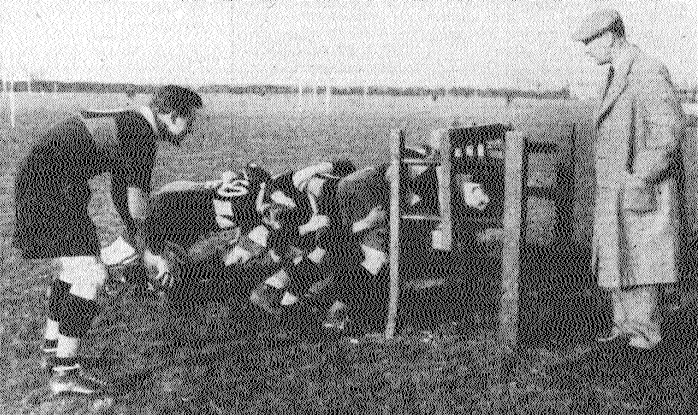
Williams would not be fully done with rugby though. After the war he became the coach and chairman of Esher Rugby Club in Surrey, which Cardiff RFC hosted in a preseason match this past summer. During his time at Esher, he maybe even had a hand in pioneering the scrum machine.
Watch the video here (opens an external link to You Tube).
Ivor Williams coaching at Esher RFC in 1950
Ivor Williams passed away in 1982, making his mark on three separate clubs.
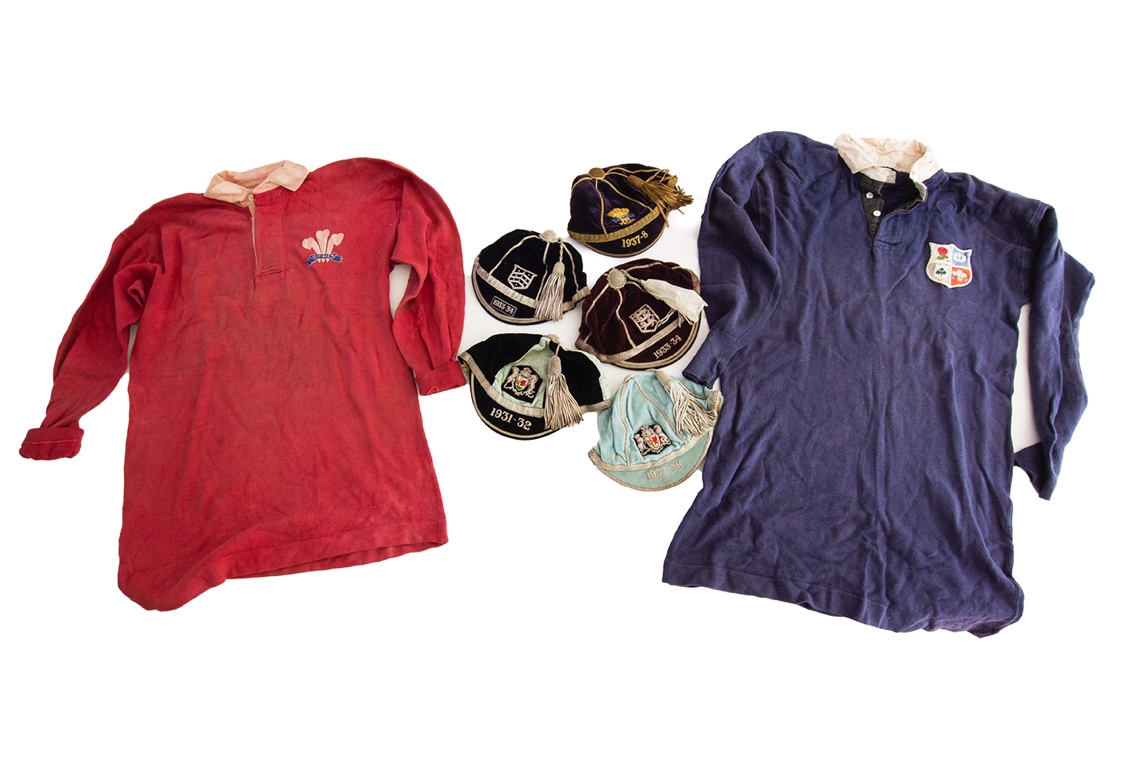
Ivor Williams’ family has kindly loaned the Cardiff Rugby Museum some of his memorabilia, which formed a central part of our previous exhibit on the British and Irish Lions.
Ivor Williams’ memorabilia on loan to the Cardiff Rugby Museum. Jerseys, left to right: Welsh trial (possibly 1934), 1938 Lions jersey. Caps, top to bottom: 1937/38 Welsh trial, Gloucester 1933/34, Gloucestershire 1933/34, Cardiff Athletic 1931/32, Cardiff 1937/38.
A special thank you to Gloucester Heritage for contributing information to this article.